Working Paper · January 2026
Global Risk, FX Volatility,
and the Real Economy
A Sign-Restricted SVAR Approach
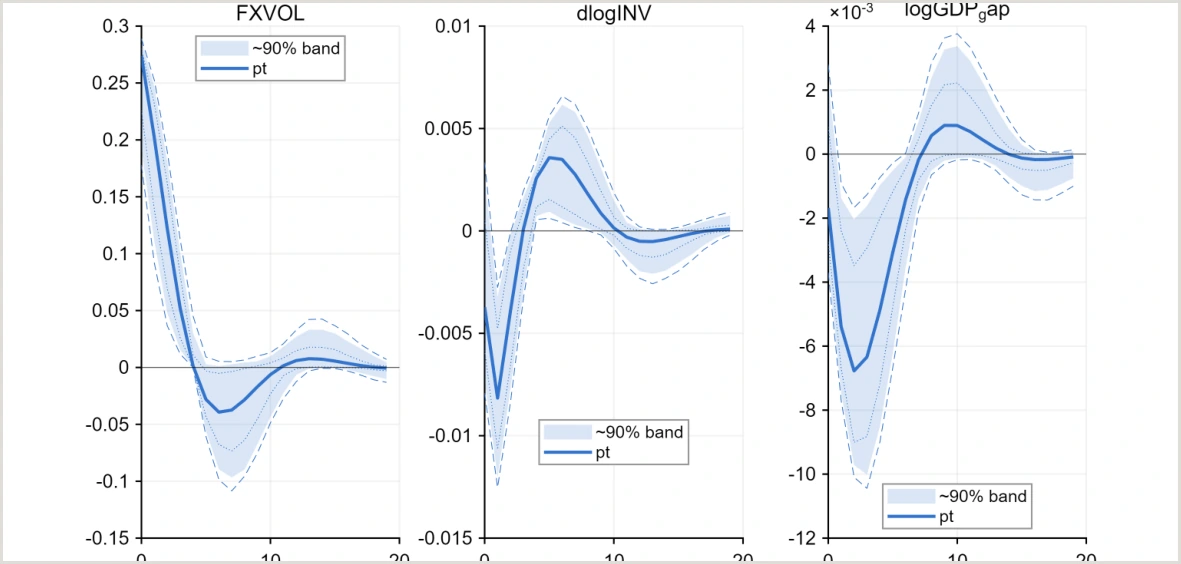
How does global risk reach a small open economy? I isolate an FX-volatility-centered shock in Korea and trace its transmission to investment and cyclical output.
At a glance
A compact empirical design built around identification, inference, and historical validation.
Finding
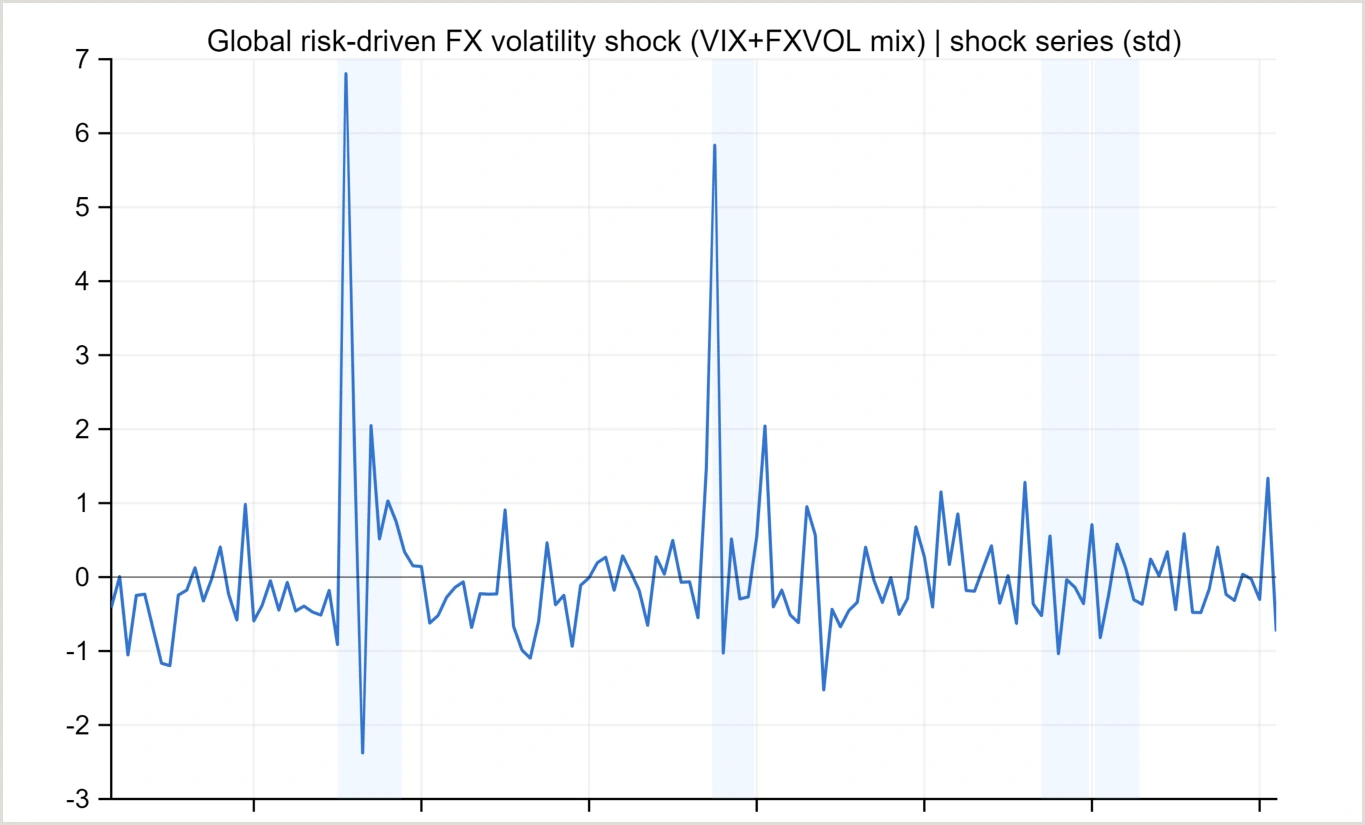
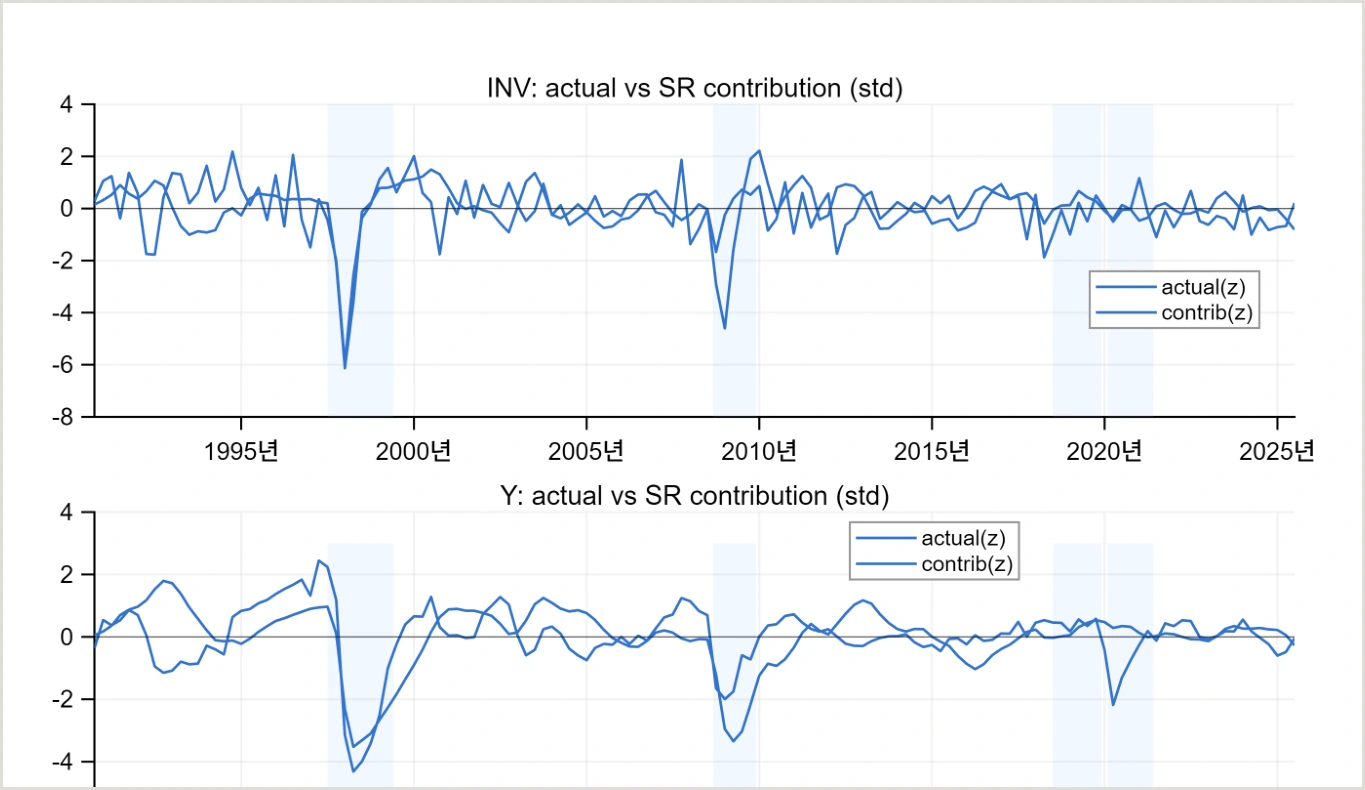
The identified shock reaches its largest realizations in 1997Q4 and 2008Q4—linking the statistical object to Korea’s two defining external financial crises.
Empirical design
The shock is selected from admissible rotations rather than imposed through a fully recursive ordering.
Quarterly VAR
[log(VIX), log(1+FXVOL), dlog(INV), Y]
Y is the HP-filtered cyclical component of a pseudo log-level GDP index in the baseline specification.
Targeted sign restrictions
Short-run restrictions define the feasible set. A max-share criterion selects the rotation that concentrates forecast-error variance in FX volatility.
Purity penalty
An auxiliary penalty discourages contemporaneous mixing with real-activity innovations; alternative weights are treated as robustness exercises.
Bootstrap re-identification
Each wild-bootstrap replication re-estimates the VAR and resolves the identification problem, carrying selection uncertainty into the confidence bands.
Historical validation
The identified series is quiet in ordinary periods and becomes economically consequential when global risk deteriorates abruptly.
Replication package
The repository is private while the paper is under revision. Its structure is designed to reproduce figures and tables without redistributing third-party data.
run_main_analysis.m
Set the quarterly CSV path, move to the repository root, and run the main MATLAB entry point. The implementation is designed not to require additional toolboxes.
Figures, tables, and logs
outputs/figures/outputs/tables/outputs/logs/
Data are not redistributed
Users obtain the underlying series from ECOS, FRED, and the EPU database, then construct the quarterly analysis file locally.
Replication detailsQuick start, required inputs, and measurement choices
Quick start
- Obtain repository access.
- Set MATLAB’s working directory to the repository root.
- Point
dataFileto the locally constructed quarterly CSV. - Run
run_main_analysis.
Required quarterly inputs
VariableDefinition
VIXGlobal risk proxy, entered as log(VIX)FXVOLQuarterly FX-volatility proxy, entered as log(1+FXVOL)INVQuarterly investment series used to construct dlogINVGDPgQuarterly GDP growth used to construct the cyclical output measureFX volatility
Daily KRW/USD log returns are fitted with a univariate GARCH model. Conditional volatility is averaged within each quarter and entered as log(1+FXVOL).
Cyclical output
Quarterly GDP growth is cumulated into a pseudo log-level index. The baseline measure is its HP-filtered cyclical component with lambda = 1600; GDP growth is retained as a robustness alternative.